
Why Your Marriage is More Important Than Your Children

This article is a spec sample written for portfolio purposes

Life as a married couple with children can be a hectic whirlwind where you’re flying by the seat of your pants. It’s hard to get time alone when you have multiple kids, let alone intimate time. Most of the time it’s like the kids are ruling you. That’s exactly why you should make your marriage a priority, even at the expense of your children.

The Value of Marriage

Marriage is the most valuable relationship in the family, after all, it was the union that brought those children into the world. You managed to find the person you wanted to spend the rest of your life with. You settled down, had children, and built a life together. Along the way, that valuable relationship can fall into the background in lieu of raising children. That’s a shame. A marriage can be so much more than two people mindlessly parenting children until it’s time for bed.

When done right a marriage can be a bond that holds a family together. It’s an escape into comfort for two people at the end of a rough day. It’s another adult to have a grown-up conversation that doesn’t involve Kid #1’s blanky that went missing or Kid #4’s rough day at daycare (real conversations in our house). Valuing your marriage is the most important investment you’ll make in your children’s lives.

Parenting Is a Partnership

The bond created when you married your spouse doesn’t have to evaporate when you have children. Instead, it needs to turn into a partnership that helps the whole family strengthen. Two people working for a common goal are better than two individuals.

That partnership also means someone to share the burdens that come with raising children. There are moments of doubt, frustration, and stress that can be a heavy weight if carried alone. Take solace in the presence of another person to lighten the load, after all, isn’t a load shared more easily carried?

A Healthy Marriage Models Behavior for Your Children

In any relationship there are ups and downs. That’s simply a fact of life. There are moments when one of you will lose your temper, saying something that was better left unsaid. It’s best if those moments happen away from the children, but let’s face it, sometimes it’s unavoidable. If the children see you argue, they should also see the resolution. The ability to apologize and forgive are skills your children can best adopt when seen in their parents.

Seeing a loving relationship as an example in their own home will help them develop healthy relationships of their own. What will your children learn from seeing their parents in different rooms every night after work? How will they learn to effectively communicate when their own parents are sitting right beside each other staring at their phones instead of talking? Healthy relationships start in the home, and they start with the two people closest to your children. You and your spouse.

Having an Outlet Eases Anxiety

Who feels the brunt of your wrath when your anxiety morphs into anger because you don’t have an outlet? Your children. Putting your marriage first takes the pressure off the children to be perfect little angels. Let’s face it, they aren’t angels, and that’s okay. Vent to your spouse when you’re frustrated. Go out to dinner when you need a break. Have the kids stay with a trusted friend or family member when you want to pull your hair out. Get that time however you can. Since I also have a full-time job in addition to writing, my evenings are spent at the desk in the corner of our bedroom. Most nights my wife lies in bed while I write (in fact, she’s there now). We can talk or just spend time together while I am working on a novel or an article. Whatever you do, find that outlet with your partner that takes the focus away from the children and back on your relationship.

It’s Okay to Have Adult Time

That brings us to the next point: don’t feel guilty about taking time away from the children to focus on your relationship. Feeling guilty seems to be a natural part of being a parent. You feel guilty because you’re spending too much time at work. You feel guilty because you’re spending too much time with one child and not another. You feel guilty because you missed Timmy’s tee ball practice. Feeling guilty because you focus on the relationship with your spouse isn’t as common. That’s likely because most parents simply aren’t doing it.

Spending time away from your children is good for your mental health. It gives you time to recharge your battery so you can be everything you need to be for them. You shouldn’t feel guilty about that, especially if you’re spending time with the person helping you raise those little darlings.

Ignoring Your Relationship Is a Recipe for Disaster

Let me take you through a scenario. Your entire life has revolved around raising your children. For two decades it was the only thing your spouse and you focused on. You made sacrifices in your relationship in order to give the children the attention they deserved. You can’t remember the last time you went out with your spouse. Then your youngest graduates from high school and moves away for college. Suddenly, it’s just the two of you in that big house. Two people who haven’t had an adult conversation or spent quality time together in years. What if you’re both different people than you were when you fell in love?

Divorce rates among adults over 50 have doubled in recent decades, a shift researchers at Bowling Green University have called the “gray divorce” trend. It’s a transitional period, when children move out and priorities change. Some couples have difficulties coping with it. Making your relationship a focal point while you’re raising children will give you tools to handle the transition with grace.

Conclusion

Your marriage is the most influential relationship in your household. It’s the heart of your family, if it isn’t healthy, the rest of the body will suffer. It’s the foundation of your family, and the building blocks for the way your children build relationships both now and in the future. Focus on your relationship with your spouse, your children’s future depends on it.

Stephen M. Roth

Praying For Signs:

When God Says No

This article is a spec sample written for portfolio purposes

When life brings challenges, the Christian has a secret weapon to wield. The power of prayer. We pray for the wellbeing of our loved ones, friends, and families. We pray for guidance, strength, and courage through difficult circumstances. We also pray for signs from God of which direction to venture when faced with uncertainty.

Sometimes those signs are favorable, as with Gideon (Judges 6:36-40), while at other times we are nullified, as happened with the Pharisees asking Jesus for a sign (Matthew 12: 38-39). More on those later. It can seem random how God decides to send signs or messages to his believers. It can seem unfair when the sign that is received sends you in an unplanned direction.

My Story

My journey has always involved writing, just not what you would imagine from the author of an article like this. I have always dreamed of being a traditionally published author. It’s something I have spent a significant amount of my prayer time over the course of the last twenty years on. Recently, I prayed for a sign that I was heading in the direction God intended. The sign received wasn’t the one I expected. My path as a fiction writer wasn’t in God’s plans for me.

Has there been a time in your life when you prayed for a sign from God only to receive an answer you didn’t expect? It may be a simple matter of faith.

Biblical Examples of Asking for Signs

Let’s look at Judges 6: 36-40:

Gideon said to God, “If you will save Israel by my hand as you have promised— look, I will place a wool fleece on the threshing floor. If there is dew only on the fleece and all the ground is dry, then I will know that you will save Israel by my hand, as you said.” And that is what happened. Gideon rose early the next day; he squeezed the fleece and wrung out the dew—a bowlful of water. Then Gideon said to God, “Do not be angry with me. Let me make just one more request. Allow me one more test with the fleece, but this time make the fleece dry and let the ground be covered with dew.” That night God did so. Only the fleece was dry; all the ground was covered with dew.

In his doubt, Gideon asks for a sign from God. Then another. In this passage we see God’s patience on full display as Gideon doubts Him, not once, but twice. He shows humility when requesting both signs. Gideon was a faithful man that sought reassurance of his path in God’s will. Deemed worthy and faithful, God provided the guidance that was sought.

Matthew 12: 38-39:

Then some of the Pharisees and teachers of the law said to him, “Teacher, we want to see a sign from you.”

He answered, “A wicked and adulterous generation asks for a sign! But none will be given it except the sign of the prophet Jonah.”

The Pharisees asked Jesus for a sign to prove his divinity. Jesus rebukes them instead. The Pharisees weren’t asking for a sign out of faith but were attempting to test Jesus, a demonstration that their motives weren’t pure (Mark 8:11).

What can we learn from these two passages when compared? Faith in God’s ability, even when doubting your own worthiness or ability to achieve what God has planned, is crucial. In fact, we are called to have faith no matter the circumstance. 2 Corinthians 5:7 says, “For we live by faith, not by sight.” Philippians 4:13 is a personal favorite of mine. It reads, “I can do all things through Christ who strengthens me.” Though we may not possess the foresight to see into the future, God does. He knows everything. We are called to trust in Him to provide our way forward, lighting our path.

The Pharisees weren’t pure of heart. Their intentions were unjust. Jesus, being God in human form, knew their intentions and refused to provide the sign they requested.

Should You Ask for Signs?

There isn’t anything inherently wrong with asking God to provide a sign, as long as the heart is coming from a place of faith. If you are testing God, good luck. Test God and your prayer will go ignored. There is a better way.

A Better Prayer Than Asking for Signs

Instead of praying for signs, pray for wisdom and the ability to discern the signs that are already in your life. Pray for your will to align with God’s will for you.

James 1: 5-7:

If any of you lacks wisdom, you should ask God, who gives generously to all without finding fault, and it will be given to you. But when you ask, you must believe and not doubt, because the one who doubts is like a wave of the sea, blown and tossed by the wind. That person should not be expected to receive anything from the Lord.

“The one who doubts is like a wave of the sea, blown and tossed by the wind.” Have you ever felt like that? I know I have. Allow God to aid you in properly aligning your will with His. Through faith all things are possible.

Conclusion

I’m still writing fiction, however, I have opened my eyes to the path that God wants me to walk, rather than asking Him to bless the path that I walk. Writing articles of faith is a part of that journey.

Walking with God isn’t about the signs that are sent to you in your daily walk. It’s about faith that he will deliver you from whatever you face, because He is with you and all things are possible through Him. Pray for wisdom and discernment. Pray to align your will with His. If you do that, you might not know the direction you’re heading, but you’ll have faith that God will deliver you there safely.

God bless,

Stephen M. Roth

Pacing: Speeding Up & Slowing Down

The pace is the speed at which the story unfolds, how quickly or slowly the events take place within the narrative. Proper pacing is essential if you want to hook a reader into turning the page long into the night or if you want to develop your character’s depth enough for the reader to have empathy for them. Both require different aspects of pacing. Understanding how to slow the story down or speed it up is crucial to success as a writer.

When to Quicken the Pace

When should you quicken the pace of your novel? Leading into the climax of the story is an obvious place to quicken the pace. You might also choose to start your novel off with a quick pace, hooking the reader with action. Maybe your previous chapter had a lot of introspection or internal monologue, and you feel it’s the right time to get things moving again. The choice is yours. So, how would you quicken the pace of your novel?

Tips For Quickening the Pace of Your Novel

  • Shorten sentences to create urgency. Shorter sentences are easier to read and keep the reader engaged. It’s also better for skimming through, which readers tend to do when the pace is quick.
  • Keep description to a minimum. Only describe what is important to the story and the action within. Unnecessary descriptions slow the story down.
  • No Internal Monologue. There isn’t usually a lot going on when a character is deep within their own mind. Save this for when you want to slow things down.
  • End Chapters on a cliffhanger. This will keep the reader engaged and turning the page to see what happens next.
  • Have quick dialogue exchanges. Quick, snappy dialogue will read quicker and move the story along faster.
  • Use shorter chapters. This will create the feeling of a lot happening in a short period of time.
  • Get in and get out of scenes. Don’t linger in a scene longer than necessary. To create a quickening pace, start at the action and end it sooner than you think.
  • Skip ahead. Don’t be afraid to skip ahead, skimming over the boring events that happen. Does your character drive to the next scene? Don’t write a scene with them in the car. Instead, skip ahead to where they are already at the location.

When to Slow Down the Pace

You don’t want to have an unrelenting pace to your novel cover to cover. Don’t get me wrong, we all love to be hooked by a fast-paced story, but you don’t always want that. There are times when you want to slow things down. For instance, when your character got out of an exhilarating scene that had the reader’s heartrate beating out of their chests. Maybe you want to focus on character development. Or maybe the main character just learned about something that alters the course of the novel. How do you slow down the pace of a novel?

Tips for Slowing Things Down

  • Inner monologue tangent. This is the time to get into the character’s mind and let out their thoughts.
  • Use longer sentences and paragraphs. Longer sentences take longer to read, therefore, slowing down the pace of the novel.
  • Longer Chapters. A long chapter can slow down the pace of a story by causing the reader to linger.
  • Linger in a scene. There are scenes that are best kept short, but here, you’ll focus on letting it stretch out.
  • Detailed description. Remember when we said to keep the description to a minimum to keep the pace moving quickly? This is exactly the opposite. Describe the scene using multiple senses.
  • Use complex language. Break out the thesaurus or that word you’ve been holding onto and use it. Complex language takes longer to absorb, slowing down the reader, and leaving them lingering in your brilliance.

Examples of Novels with Good Pacing

The Lockwood & Co. series by Jonathan Stroud is a good example of how to pace your novel. Each novel starts with the psychic detective agency (Lockwood & Co is agency’s name) in the heart of an investigation into a paranormal event. It starts off quick, hooking the reader with action, before slowing down so you can get to know the characters.

Stephen King is a master of the slow building horror story. The Shining is a personal favorite of mine. Jack Torrance seems like a normal, but flawed husband and father at the beginning of the book. It slowly builds to a terrifying climax.

My Pacing Issues

I have thought a lot about pacing over the course of the last year or two. I know in hindsight that Reel Ghosts, my debut novel, suffered from pacing issues. It’s too slow in the beginning chapters, taking longer than needed to get to the main part of the story. I tried to rectify that with The House That Wasn’t There, which I believe I did, for the most part. Yet I focused so much on keeping a fast pace that I forgot to stop and linger occasionally. The end of the book suffered because of it. With my current work in progress, Cult of the Macabre, I’m focusing on landing somewhere between the two novels, with a slow building plot with a satisfying ending.

Conclusion

Pacing is the key to both hooking the reader and making sure they have spent enough quality time with your characters to appreciate them. There are times when you will need to speed things up and slow it down. Knowing when to do so is half the battle of this beautiful thing we call writing.

Thanks for reading,

Stephen M. Roth

If you enjoyed this post, please follow, like, and share. Remember to follow your dreams, even if they terrify you. “I can do all this through Him who gives me strength.” Philippians 4:13

Stephen Roth

Social media links:

X: @StephenRoth316

Bluesky: @stephenrothwriter.bsky.social

Instagram: @StephenRoth316

TikTok: Stephen.Roth6

Accepting What I am

(There will be a preview of my new novel, The House That Wasn’t There, at the end. If you’re just here for that, skip to the bottom.)

When we are young, we’re filled with dreams and ambitions of what we will achieve in our lives. Some of us want to climb Mt. Everest, while others want to become a famous actor. My dream since I was little was to be a published author. More specifically, I dreamed about seeing my book on the shelf of my local bookstore. Being a famous author wasn’t necessarily the dream, just being a traditionally published author would suffice.

I finished my first novel when I was twenty-five years old. It was rejected by the three literary agents I sent it to. Yes, you read that right. I sent it to a total of three literary agents. Thanks to the advancement of the internet, and the popularity of Googling information that we don’t know but want the answer to, I now know that three wasn’t enough. That’s alright, it wasn’t publishable by any stretch of the imagination.

Eventually, I learned that three wasn’t enough and sent my next manuscript to twenty-five agents. The following manuscript was sent to more than fifty. Reel Ghosts was sent to at least fifty, as well. All of those manuscripts had the same thing in common. They were rejected.

I was blindly repeating the same mistake over and over again, which I wrote about when discussing why I decided to self-publish. My focus on the dream had blinded me to reality and what the world was telling me. I wasn’t going to be a traditionally published author.

A wild backup plan became “the plan.” Back when X was Twitter, I posted about my backup plan being self-publishing my book. I was looking for insight, which I received. I also received plenty of comments regarding my usage of the term backup plan. Self-published authors weren’t happy that I used it in that manner. Years down the road, I stand by that terminology, at least for me. The fact is, if I could be a traditionally published author today, I would likely take it. Of course, it would come with a cost. My control would be limited. I would also still have to do some of the same marketing for the book that I do now. It wouldn’t be easier, just a different sort of journey.

Full disclosure. I didn’t send The House That Wasn’t There to a single literary agent, like I had planned. Seeing Reel Ghosts do little to nothing in the self-publishing world was and still is hard. Plus, The House is a better novel. I want good things for it. Yet, I have come accept what I am, a self-published author.

It’s a humbling experience for a man who has read many books and thought “Are you kidding me? My book is better than this! Why do they have an agent and a publishing deal?” If you choose to read The House That Wasn’t There, which deals with the 7 deadly sins, you’ll find out which two I committed.

Because of the experience of the last year and a half, I know what I am. I’m a good, but not great writer. There are worse, true, but there are a lot that are better. That’s fine with me; I’ll keep writing regardless. Hopefully, you’ll keep reading.

The Preview

Here’s the back of the book description:

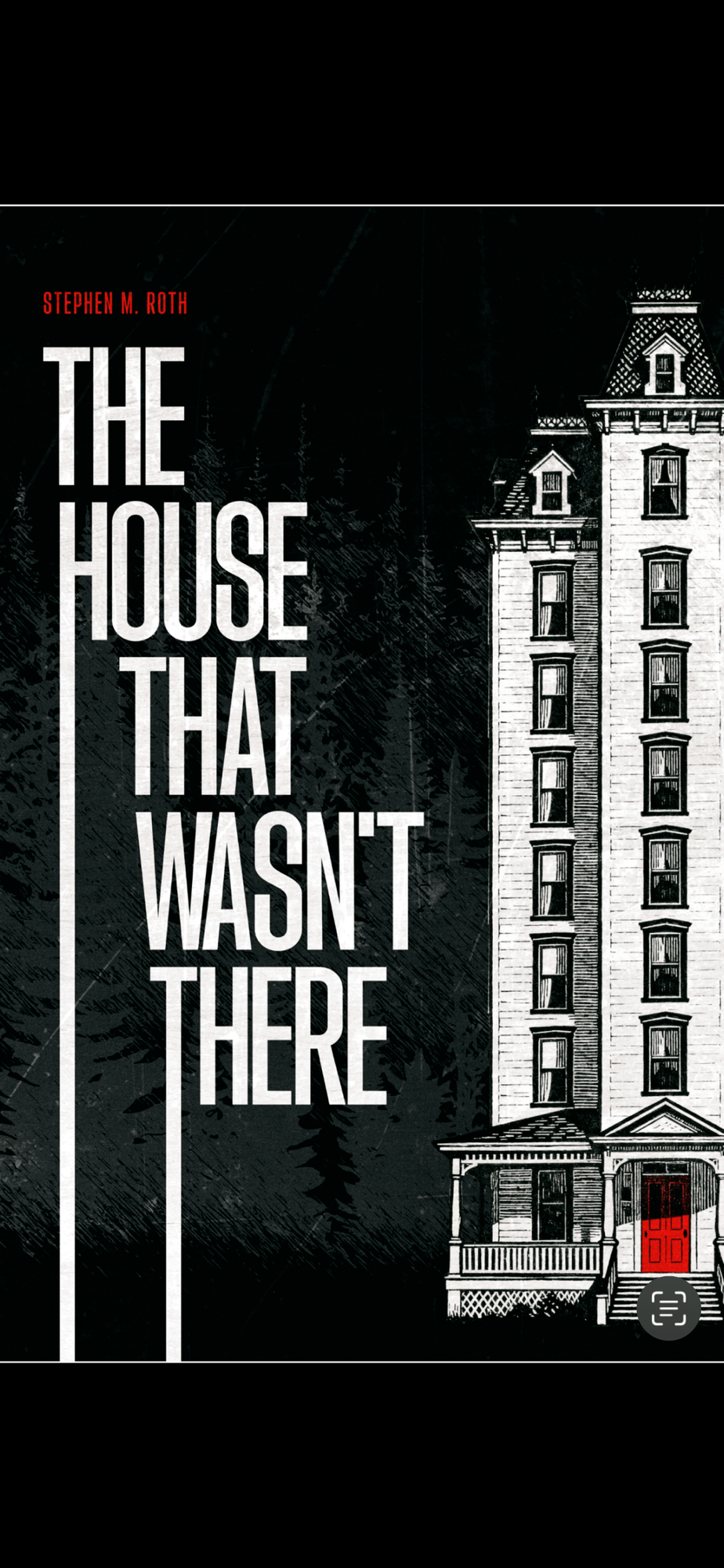
There wasn’t supposed to be a house hidden in the woods across the street. There weren’t any visible signs of construction in the area. Being a residential construction worker, Conner knew a construction site when there was one. There wasn’t one.

It was as if the house appeared overnight.

It beckoned to him, calling out for him to enter, until he had no choice but to step inside.

It knew his sins and tormented him with them, making him relive every heartbreaking choice that shattered his life.

The worst part? There’s no way out.

Interesting, right?

Since you’re reading this blog post (thanks, by the way) how about a further look into the book?

This isn’t the first time that Conner has encountered the house, which you’ll learn more about when you read the book. Ten years ago, he was part of an investigation into the disappearance of a woman. Her husband said that in the week leading up to her disappearance, she claimed to see a house across the street in the empty lot. The problem? There wasn’t a house there.

The house is seven stories tall, with a different level where the wanderer experiences an occasion they committed that particular sin. While they are in the house, it feeds on their soul.

While in the house, Conner experiences the sins he committed while investigating the disappearances involving the house ten years ago. Sins that caused him to flee his life for a new one.

Here’s a link to the Amazon page where you can buy the book.

Thanks for reading.

If you enjoyed this post, please follow, like, and share. Remember to follow your dreams, even if they terrify you. “I can do all this through Him who gives me strength.” Philippians 4:13

Stephen Roth

Social media links:

X: @StephenRoth316

Bluesky: @stephenrothwriter.bsky.social

Instagram: @StephenRoth316

TikTok: Stephen.Roth6
To Be or Not to Be a Christian Writer

In recent posts I’ve written about my faith as a Christian (here and here). I’ve also written about my passion for writing. Outside of family, those are my greatest passions, loves, and reasons for being. It occurred to me recently that some of you might be wondering why I haven’t blended the two. In other words, why am I not a Christian writer? Well, it’s a complicated answer, and I can’t say it won’t change somewhere down the road. Here it goes.

Let’s start off with a reiteration of my faith and why it’s important to me. I believe that Jesus Christ is the son of God. That he came down from heaven, lived a perfect life, and died for the forgiveness of my sins. I, a sinner, condemned, unclean, am made clean by that sacrifice, which was accepted by baptism. That’s the Good News. That’s what I believe. I have refrained from sharing my story on this blog in the past. Now, I fear I was wrong. After all, am I not called to proclaim the Good News? That’s what this is. That’s what this is about.

Now, Let’s talk about why I write. I’m sure that I’ve written about this before, but it’s good to reiterate the point here. I write because I must. That’s the short answer. The long answer is that it’s a compulsion, an itch inside my brain that must be scratched. I write for the way it makes me feel afterward. I write because I’m a better person when I have a creative outlet in a world where I can control so little. I write for all the reasons that were in the previous blog post. I could go on and on, but I think you get the idea.

So, what is a Christian writer?

A Christian writer is a writer that chooses to write for a Christian audience. That’s usually through the confines of the Christian genre of fiction. For the purposes of this blog, we’ll only be discussing fiction, although I’ll get to nonfiction at the end.

Why don’t I write Christian fiction?

It’s a personal choice, honestly. Horror was my first love. That wouldn’t change, even if I decided to write Christian fiction. Christian horror does exist and could be an option down the road. For now, however, it simply isn’t for me. I am a big proponent of reading what you write and vice versa. I read horror, not Christian horror. The Christian writing I intake is of the nonfiction variety, mostly having to do with spiritual growth.

I write mainstream horror, but with a code of ethics that derive from my faith as a Christian. In the two blog posts linked above, I documented my struggles with maintaining that code of ethics. I try not to use profanity in my writing, though have at times in the past. In The House That Wasn’t There, my upcoming novel, I stayed true to those ethics. There is an intentional use of profanity later in the book, symbolizing the struggles that remain in my life. It’s a good book. I hope you read it when it comes out, hopefully later this year.

The choice to continue writing mainstream horror instead of changing to Christian horror, despite the calling I’ve felt recently to speak out on faith, was an intentional one. My fiction is the most likely way I can make a widespread impact on nonbelievers. “But Stephen, you don’t write Christian horror. How will you have an impact on them?” Most readers will read my novel and move on with their lives, and that’s fine. A few of them, however, might decide to visit the website in my author profile (this website). Here they will find a writer that talks about the struggles he has had in his writing career. Hopefully, that will help them with their own struggles. They will also find posts like this one, where a writer proclaims his faith, unafraid of what the world will think of him. You see, what good is proclaiming the Good News if it’s only done to those that already know? It’s those that haven’t heard, the doubters and the naysayers, that I’m trying to reach.

I hope this post clears up any confusion about the purpose of this blog going forward. There will still be writing related content, however, there will also be more posts like this. If you like this post and think I should do more like it, leave a comment below.

One last thing. Reel Ghosts is struggling with getting reviews. I am willing to send a copy of that book to two readers willing to CONSIDER leaving a review on Amazon. Simply considering leaving a review is enough. Send me an email if you’re interested (sroth2006@yahoo.com). I’ll post in the comments when this offer has closed.

I know this is my first post in a while. I’ve been working on getting some freelance writing samples done while working on a new novel. Writing about faith is something I’m considering with freelance writing. The other topics are parenting/family and digital marketing. Let me know your thoughts in the comments.

If you enjoyed this post, please follow, like, and share. Remember to follow your dreams, even if they terrify you. “I can do all this through Him who gives me strength.” Philippians 4:13

Stephen Roth

Social media links:

X: @StephenRoth316

Bluesky: @stephenrothwriter.bsky.social

Instagram: @StephenRoth316

TikTok: Stephen.Roth6

What’s Going On

It’s been a while since I’ve given you an update on what’s happening in my writing career. So that’s what we’ll do this week.

  • Reel Ghosts has been out over a year now. It’s been a learning experience, mostly in what not to do. For most of that time I didn’t promote or advertise the book. That’s what I’m doing now. If you’ve read Reel Ghosts, consider leaving a review.
  • My next novel, the House That Wasn’t There, is in the hands of a few first readers. I accidentally gathered a group with varied skills. Some are good with readability, while others are picking out some mistakes on my part.
  • A cover is next for the House. With Reel Ghosts I thought I needed to spend hundreds of dollars on a cover. Unable to afford it, I opted for an AI image for the cover. This time I’ll be hiring an artist on fiverr. A date for release isn’t set, but I’d like a few months to promote the release.
  • I started a new novel last week, tentatively titled the Devotee. It’s about a psychology student that interviews a horror writer about his influence on his fans for her thesis, and subsequently joins a cult with the writer as the leader.
  • It’s a different story than anything I’ve written for 2 reasons. First, as you may have noticed in the brief description, I said her. That’s because the main character is a woman. I’ve written short stories about women before, but this will be the first novel. Second, it’s first person POV (I/ me) instead of my usual choice, 3rd person (she/her). It felt right when developing the story. 3 chapters in and it feels like the right decision.
  • I’m working on a short story collection. The grind of finding magazines for my short stories has been something I’ve struggled with in the past. In fact, over the last few years, I’ve not tried to find magazines for most. Instead, they’ve sat collecting dust. In my spare time I’m editing the stories I’ve written and putting together a collection for an ebook. This is a recent undertaking so there’s no timetable for publication.
  • Another plan for the future has to do with my middle grade fiction. In the early years of this blog, I posted about my trials and tribulations querying literary agents regarding my middle grade novels. Now that I’ve committed to self-publishing, it’s time to get those stories out to the world. From Darkness Comes will be first, as a standalone book. Then I’ll turn my attention to the Breaking Character series. The first book is done, but needs a fresh eye. I’ve grown as a writer since then and know it’ll need work. The first draft of the second book is done and needs edited. The third book is unwritten. Is 3 books enough for a series? Should I write more? Let me know your opinion in the comments.
  • I’m planning on doing some freelance writing soon. Articles, blog posts, and whatever sounds interesting. I’d like to turn writing into a career. If you have a need for writing services, send me a message.

If you enjoyed this post, please follow, like, and share. Remember to follow your dreams, even if they terrify you. “I can do all this through Him who gives me strength.” Philippians 4:13

Stephen Roth

Social media links:

X: @StephenRoth316

Bluesky: @stephenrothwriter.bsky.social

Instagram: @StephenRoth316

TikTok: Stephen.Roth6

The Greatest Feelings of Writing

The last few blog posts have been on the heavier side, so I thought I’d lighten it up. I’ve talked a lot about the lows of writing on these pages, but we can’t forget about the good as well. Here is my personal list of the greatest feelings of writing (that I’ve experienced):

  • That first published story. I was nineteen years old when my first story was published. It was a literary piece about domestic abuse involving the parents of a teenage driver that was killed in a late-night accident. The magazine no longer exists, and the title of the magazine escapes me. It was thrilling. Seven years would pass before I would publish another story.
  • Eureka! That moment when inspiration strikes at a moment you weren’t expecting it. I often brainstorm for new story ideas when between projects. The process is simple: get a notebook, pen, and try to fill a page with ideas. That’s not what I’m referring to here, however. I’m talking about when a story idea hits you when you were least expecting it. It usually happens when my mind is preoccupied with something else. This might be my favorite moment because I’ve found these ideas are often better than the brainstorming variety.
  • The excitement of starting a new story. There are few things like starting a new story, right? It could be the best story you’ve ever written. It could be the one to break out, making you a household name. The possibilities are endless.
  • Finishing the first draft. It’s a great feeling, isn’t it? Obviously, the work is far from done, however, it’s good to celebrate achievements. Finishing the first draft definitely applies.
  • Reading the first draft & realizing it’s good. The majority of my first drafts look like most writers, which is rough. That’s because the goal of a first draft is to get the story out of your brain and onto paper as quickly as possible. You can clean up the mess later, that’s what editing is for. Seeing the potential in a story through all the flaws is a good feeling.
  • When a work-in-progress is turning out as you’d imagined it in your head. This doesn’t happen to me very often (probably because I’m a plantzer, rather than a full-fledged plotter, and the idea is fluid as I write), when it does, however, it’s rewarding. This happened with my middle-grade novel, Breaking Character.
  • Finishing the final draft. This is the finish line, and it feels good to cross it. Of course, this might not be the true final version of your novel. This would be the step in the process where you would send it to an editor, if you can afford one, that is. For those on a tight budget (like me) this is the time that I hand it over to a several trusted readers. There will likely be a few changes to make along the way, especially if you hire an editor. By the time you reach the final draft, you’re likely tired of the story. I usually celebrate this because it means I get to move onto my favorite part of the process.
  • Holding the first copy of your book in your hands. Whether you’re traditionally published or self-published, there’s nothing like holding your own book in your hands.
  • Receiving compliments about your book/writing being impactful. Most of the compliments I receive have been from people that read this blog (thanks, by the way). There’s no greater feeling than hearing what you’re doing is being noticed and appreciated.
  • Realizing your self-published book is better than the traditionally published book you’re reading. Yep. If you’re a writer, then I would wager you’ve read a book that was traditionally published that wasn’t good. I’ll refrain from naming titles, however.

If you enjoyed this post, please follow, like, and share. Remember to follow your dreams, even if they terrify you. “I can do all this through Him who gives me strength.” Philippians 4:13

Stephen Roth

Social media links:

X: @StephenRoth316

Bluesky: @stephenrothwriter.bsky.social

Instagram: @StephenRoth316

TikTok: Stephen.Roth6

Devil Whispers

My dream has always been to be a traditionally published author. When I started writing fiction as a teenager that was one of the only ways to have your fiction read. I read R.L. Stine as a kid, Christopher Pike as a teenager, and graduated to Stephen King as an adult. My heroes were all traditionally published authors. It was natural that I would take the same path as they had. At least, that was the thought, however, my path was unlike those three. I shouldn’t have been surprised, after all, we all have our own separate journeys.

That journey wasn’t a straight line, as there were twists, turns, and much backtracking along the way. First, there was the lack of success with building my portfolio of published short stories to prove to literary agents that readers wanted to read my work. There were publications, but not as many, nor as frequent as I desired.

Eventually, I felt as if I had enough credits to my portfolio to entice an agent into representing me. I was sorely mistaken. Rejection after rejection for book after book followed. I switched from writing middle grade horror to adult horror and faced the same results. The early years of this blog chronicle that journey and the struggles I had along the way.

I have written about rejection in the past (here’s the link), but it’s been a while. Years of rejection, of hearing that you’re not good enough from a group of people, can have a devastating effect on self-esteem. For years, I walked around in a perpetual haze of gloom that I wasn’t aware of. At the time, I was working a job that I didn’t like while dreaming of escaping to a world as a full-time writer. A world that wouldn’t let me past the gatekeeper. Full truth? I don’t know where I’d be today without my wife and children. In my eyes, they were the only thing I had done that was worth anything.

That’s the devil speaking, whispering into my ear that I’m not good enough. That I’m not worthy. Negative thoughts are the devil’s work. Helping me forget about the blessings I had in my life. I should have ignored those whispers. Instead, I let them fester over time, eventually becoming a plague of the soul.

Roughly two years ago, I began to ponder what it was that was holding me back from becoming the writer that I knew I was destined to be. Those whispers came again. This time hissing sweet nothings into my ear about the tactics that other horror writers used that I had refrained from in my career thus far.

You see, I’ve written more middle-grade fiction than anything else in my life. In fact, I know I’m destined to return to those campy tales of horror in the very near future. That topic is for another day, however. There aren’t many middle-grade authors that curse in their writing, and for good reason. Those books have to be parent or librarian approved.

There was also the matter of my faith as a Christian. I have always kept a clean tongue, though it was speckled with imperfections more often than I’d care to admit. Simply put, profanity and Christianity aren’t cohesive. There was a reason I had kept it out of my writing, even for a more mature audience.

According to those whispers, I was holding back and only needed to stop doing such to reach my full potential. I indulged those devil whispers while writing Reel Ghosts and continued doing so in the first draft of The House that wasn’t There. As I stated in my previous post, cleaning the profane language from the first draft of The House was my penance for the sin of giving into temptation.

Cursing in my writing went against all that I stand for, which is to be the man God has envisioned me to be. It’s not about me. It’s about Him. That’s the truth for me. Be true to yourself without abandoning your beliefs and values. I know that isn’t an answer that will sell a million copies or put me on the bestseller’s list and that’s okay. It’s about being able to look at myself in the mirror every day. It’s about trying each day to be the man my children think I already am.

If you enjoyed this post, please follow, like, and share. Remember to follow your dreams, even if they terrify you. “I can do all this through Him who gives me strength.” Philippians 4:13

Stephen Roth

Social media links:

X: @StephenRoth316

Bluesky: @stephenrothwriter.bsky.social

Instagram: @StephenRoth316

TikTok: Stephen.Roth6

Have You Read Reel Ghosts?

About an hour ago, I finished what likely was the final edit on The House That Wasn’t There. Stay tuned for more information on that in the near future, but that’s not why I’m writing this. The title says it all, doesn’t it? Have you read Reel Ghosts? If you have, please consider leaving an honest review. That could be on Amazon or Goodreads. It doesn’t matter where, just leave a review.

As an Indie author, customer ratings and reviews are valuable to help other readers make the decision to read our books. Let me know in the comments if you’ve read Reel Ghosts.

Don’t forget to like, follow, and share if you enjoyed Reel Ghosts.

Stephen Roth

Social media links:

X: @StephenRoth316

Bluesky: @stephenrothwriter.bsky.social

Instagram: @StephenRoth316

TikTok: Stephen.Roth6

A Christian & A Horror Writer

*A quick disclaimer: in this post, I’ll be discussing my faith. I have refrained from speaking at any length about my faith as a Christian in the past. That is of the past. In the future I will speak of my faith in God without apologies. If that offends you, well, too bad. There are a lot of writer blogs out there, I’m sure you can find another.

With that business out of the way, allow me to introduce myself. My name is Stephen Roth and I’m a horror writer. The world of the macabre has fascinated me since an early age. I remember watching Friday the 13th with my younger sister when I was maybe 8 or 9 and reading any Goosebumps book I could get my hands on a few years later. As a teen, I graduated to Christopher Pike, though those stories were written with a female audience in mind. It was around that time I started writing my own stories. They weren’t good, but they were mine. Those stories were cheap imitations of my heroes, something that wouldn’t be broken until I was well into my twenties.

I have spent significant time writing both middle grade horror and adult horror. My late teenage years, a year or two in my twenties, and roughly half of my thirties were spent writing middle grade horror. Most of my twenties were spent writing short stories in the adult horror genre with the hope of padding my portfolio in preparation to query literary agents. I finished my first adult horror novel at the age of twenty-five. The previous five years have been focused on adult horror. Last year, I self-published Reel Ghosts on Amazon. It’s been a humbling experience but we’re not here to talk about that.

For most of that time, I’ve been a Christian. I met my wife when I was nineteen when we both worked at a movie theater. We started dating clandestine, due to the fact that I was an assistant manager and she wasn’t. There was a lot of drama back then, especially for a self-proclaimed “boring guy.” Most of it involved how my wife was treated by fellow co-workers when we started dating. Eventually, I left the theater, solving a problem for my general manager, who had grown suspicious.

I’d like to say that when I became a Christian it encompassed every aspect of my being, however, that wasn’t the case. Like a lot of Christians, I had two separate selves, one for Sunday and another, completely separate one for the rest of the week. Compartmentalization was my problem. I know I’m not the first Christian to have this problem and I won’t be the last.

This problem can be seen in my novel, Reel Ghosts. I’m proud of that novel, though it highlights the compartmentalization that I was suffering from at the time. Years of rejection had turned me bitter and desperate to the point that I let my dreams overshadow God’s will for me. I’m planning on going into further detail on this issue in my next post but allow me to give you the cliff notes.

I had always felt as if I had been holding back when it came to my adult horror fiction. In all my years of writing for adults, I had refrained from using profanity in my work. I did that despite letting occasional profane language slip from my tongue. Rather than clean-up my language to better emulate the image my Creator had for me, I instead molded my writing for my own personal gain. Unsurprisingly, at least as I look back now, Reel Ghosts, didn’t sell to agents, and instead was self-published.

I wish I could say that my error was realized immediately. Unfortunately, that wasn’t the case. In fact, in the first draft of my work in progress, The House That Wasn’t There, I approached the story in the same manner, using the same profane language, in other words. Apparently, I hadn’t learned my lesson.

So, what changed? What happened that made me realize that I had made a catastrophic mistake? Honestly, I don’t know. Over the past six months, I’ve been trying to become a better man, a better Christian man. Rather than listening to podcasts at work, I started listening to audiobooks about spiritual growth. It had been years since I opened the bible on a daily basis. That is something I recently changed. I also started listening to Christian music, something I had always thought was for those “crazy-spiritual Christians.”

I’m not a perfect man, nor am I a perfect Christian. I’m simply trying to be the man that God wants me to be. I might be a little slow to listen, but I’m getting there. With His help, I know I can.

A Christian and a horror writer can coexist in the same person. Putting Him first is the key. It took me a long time to realize that. The editing sessions on The House That Wasn’t There have been good for my soul. Each deletion of profane language is like a cleansing. It’s not easy, but it’s my penance for listening to those devil whispers.

As I said in the disclaimer above, I have refrained from speaking about my faith on this page. That was part of putting myself before God. That changes now. I will speak of my faith unapologetically from hence forth, hopefully, you’ll still read.

Thanks for reading. Remember to follow your dreams, even if they terrify you. You know what? That won’t do anymore. “I can do all this through him who gives me strength.” Philippians 4:13

Stephen Roth

Christian & Writer